
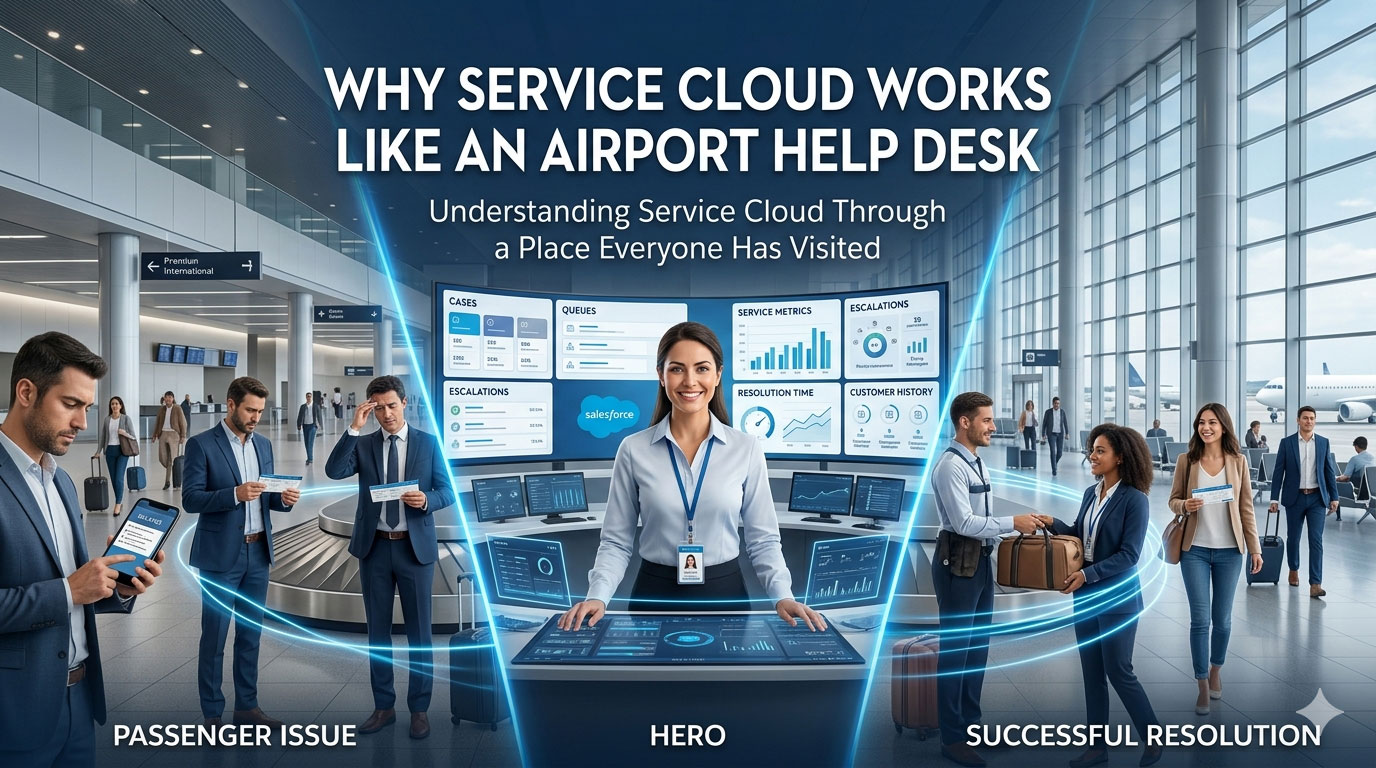
Introduction
Imagine arriving at a busy international airport.
Thousands of passengers are moving through terminals.
Flights are taking off.
Baggage is being transported.
Announcements are being made.
Everything appears organized.
Now imagine something goes wrong.
- Your baggage is missing.
- Your flight is delayed.
- Your boarding pass isn’t working.
- Your gate has changed.
Who do you approach?
The Airport Help Desk.
Without a help desk, even a well-organized airport can quickly become frustrating.
Businesses face the same challenge.
Customers have questions.
Customers have issues.
Customers need assistance.
And that is exactly why Service Cloud exists.
Imagine an Airport Without a Help Desk
A passenger enters the airport.
Suddenly multiple problems appear.
- Boarding issue
- Flight delay
- Missing baggage
- Ticket problem
The passenger looks around for assistance.
But there is no help desk.
No support team.
No resolution process.
What happens next?
- Confusion increases
- Frustration increases
- Delays increase
- Customer satisfaction drops
The airport becomes difficult to navigate.
Not because flights stopped operating.
But because customer support disappeared.
Businesses Face the Same Challenge
Customers interact with businesses every day.
They may need:
- Product support
- Billing assistance
- Technical help
- Service requests
- Complaint resolution
Without an organized support system:
- Requests get lost
- Response times increase
- Customers become frustrated
- Brand reputation suffers
The problem is rarely the product itself.
The problem is often the support experience.
Service Cloud Is the Airport Help Desk
Service Cloud does for businesses what a help desk does for an airport.
It ensures customers receive assistance quickly and efficiently.
Just as passengers rely on help desks, customers rely on support teams.
Service Cloud helps organizations manage these interactions at scale.
Airport Help Desk vs Service Cloud
| Airport Help Desk | Service Cloud |
|---|---|
| Passenger | Customer |
| Help Desk Agent | Support Agent |
| Passenger Issue | Case |
| Help Desk Queue | Case Queue |
| Escalation Desk | Case Escalation |
| Airport Display System | Service Dashboard |
| Passenger History | Customer History |
| Resolution | Case Closure |
| Service Metrics | Service Reports |
What Happens at an Airport Help Desk?
- Passenger reports an issue.
- Help desk agent creates a request.
- Issue is assigned to the appropriate team.
- Progress is tracked.
- Issue is resolved.
- Passenger continues their journey.
The goal is simple:
Resolve issues quickly while maintaining a positive experience.
Service Cloud Works the Same Way
- A Case is created.
- The case is assigned.
- Support agents investigate.
- The issue is tracked.
- Resolution is provided.
- The case is closed.
The process feels remarkably similar to airport support operations.
Key Takeaways
- Airports rely on help desks to assist passengers.
- Businesses rely on Service Cloud to assist customers.
- Cases in Service Cloud are similar to passenger support requests.
- Queues, escalations, and dashboards improve service efficiency.
- Great customer support builds trust and loyalty.
- Service Cloud helps organizations deliver consistent customer experiences.
- Support is not just about solving problems—it is about creating confidence.
Final Thought
A help desk does not fly airplanes.
A help desk does not transport baggage.
A help desk does not operate the airport.
Yet every successful airport depends on it.
Similarly, Service Cloud does not manufacture products or generate revenue directly.
But it ensures customers receive the support they need when problems arise.
And in today’s world, great customer experiences often become a company’s biggest competitive advantage.
That is why Service Cloud works like an Airport Help Desk.
Continue Learning
If you enjoy Salesforce concepts explained through real-world analogies, visual learning, and practical business scenarios, join our WhatsApp Channel.
- Service Cloud Concepts
- Salesforce Development
- Lightning Web Components
- Integration Learning
- Career Guidance
- Industry Insights
- Learning Resources
About Salesforce Gyaan Academy
At Salesforce Gyaan Academy, we simplify complex Salesforce concepts using:
- Real-life analogies
- Visual learning
- Business scenarios
- Practical examples
- Architecture thinking
- Real-world projects
Because understanding concepts is far more valuable than memorizing syntax.
📧 Email: salesforcegyaan@gmail.com