
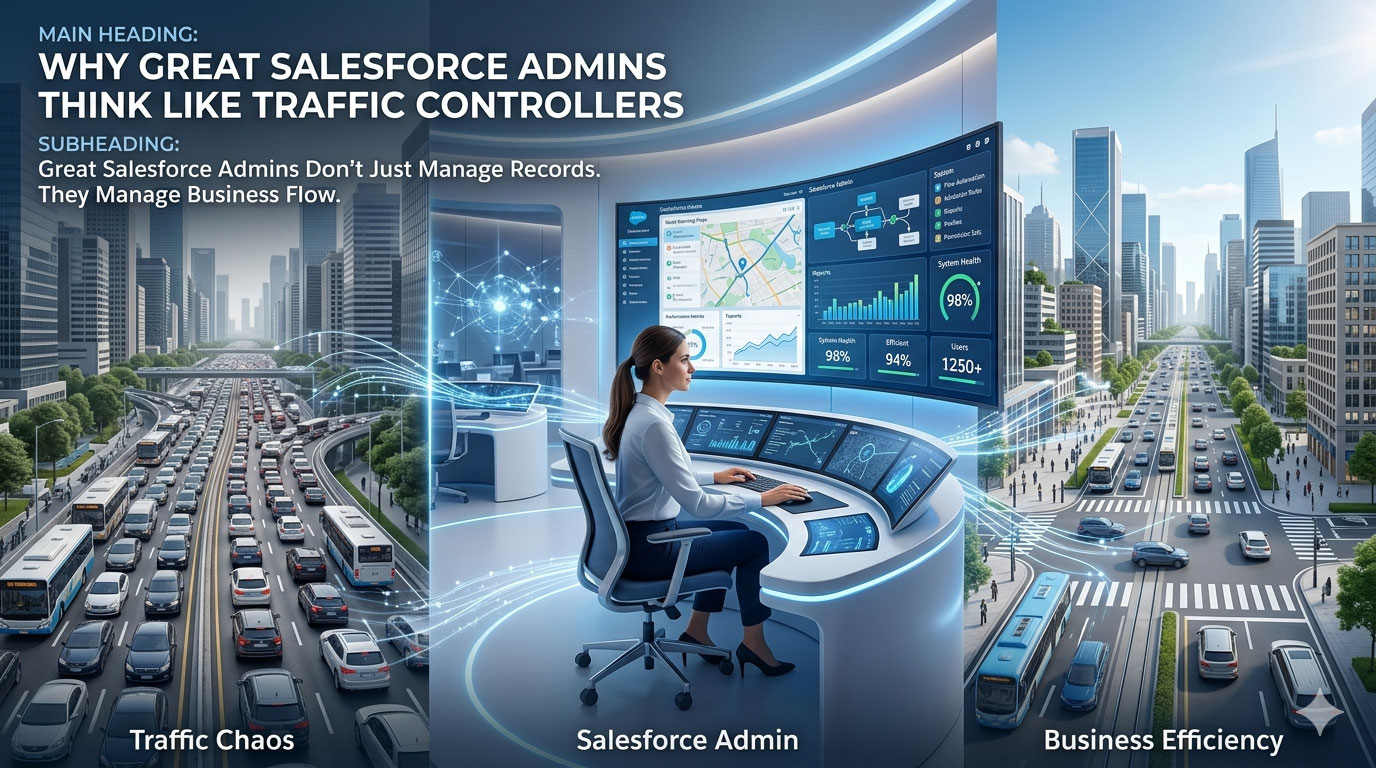
Introduction
When most people think about a Salesforce Admin, they imagine someone who creates fields, updates page layouts, builds reports, and manages users.
While those activities are certainly part of the job, they don’t capture the true value of a Salesforce Admin.
In reality, great Salesforce Admins do something much bigger.
They manage how information, people, and business processes move throughout an organization.
To understand this better, let’s step outside Salesforce and visit a busy city.
Imagine a City Without Traffic Controllers
Think about a large city with:
- No traffic signals
- No road rules
- No route planning
- No monitoring systems
- No traffic management
What would happen?
Within a few hours:
- Traffic jams would increase
- Accidents would occur frequently
- Emergency vehicles would get delayed
- People would become frustrated
- Businesses would suffer
The city would slowly fall into chaos.
Not because there are too many vehicles.
But because there is no system controlling how those vehicles move.
The Traffic Controller Doesn’t Drive Cars
This is the most important part of the story.
A traffic controller does not:
- Drive cars
- Drive buses
- Deliver packages
- Transport passengers
Instead, they:
- Create rules
- Control movement
- Monitor traffic
- Prevent congestion
- Improve efficiency
- Ensure safety
Their job is not to participate in traffic.
Their job is to make traffic work smoothly.
Salesforce Admins Play the Same Role
Inside Salesforce, many people interact with the system every day.
- Sales representatives create opportunities.
- Support agents manage customer cases.
- Managers review dashboards and reports.
- Developers build custom solutions.
But who ensures everything works together efficiently?
The Salesforce Admin.
A Salesforce Admin is responsible for creating structure, enforcing standards, improving efficiency, and ensuring users can do their jobs effectively.
Just like a traffic controller keeps a city moving, a Salesforce Admin keeps business processes moving.
Salesforce Admin vs City Traffic Controller
| City Traffic Controller | Salesforce Admin |
|---|---|
| Traffic Rules | Validation Rules |
| Road Access Permissions | Profiles |
| Special Access Roads | Permission Sets |
| Traffic Signals | Flow Automation |
| Traffic Monitoring Cameras | Reports |
| Traffic Control Room | Dashboards |
| Route Planning | Business Process Design |
| Traffic Management | User Management |
Suddenly, the role becomes much bigger than creating fields and reports.
A Real Salesforce Scenario
Imagine a sales organization using Salesforce.
Without proper administration:
- Duplicate records start appearing
- Important information is missing
- Incorrect values get entered
- Approval processes are bypassed
- Reports become unreliable
Very quickly, users lose trust in the system.
Management starts questioning the accuracy of reports.
Teams create their own spreadsheets outside Salesforce.
Productivity begins to decline.
The CRM system becomes difficult to manage.
This is the business equivalent of a city stuck in traffic.
What Great Salesforce Admins Actually Do
Data Quality
They ensure information entered into Salesforce is accurate, complete, and reliable.
Security
They make sure users have access to the right information while protecting sensitive data.
Automation
They reduce repetitive manual work through automation and workflows.
User Experience
They simplify processes so users can work efficiently.
Reporting and Visibility
They help leadership make informed decisions through accurate reporting and dashboards.
Process Optimization
They continuously improve how teams work within Salesforce.
The Hidden Cost of Poor Administration
Many organizations invest significant money in Salesforce.
However, when administration is weak:
- User adoption decreases
- Data quality deteriorates
- Business processes become inconsistent
- Reporting loses credibility
- Productivity suffers
Eventually, people blame Salesforce.
But the problem is often not the platform.
The problem is the absence of proper process control.
Just like traffic chaos is rarely caused by vehicles themselves.
It is usually caused by poor traffic management.
How Great Salesforce Admins Think
Before implementing any change, experienced Salesforce Admins ask important questions.
- Who Will Use This? – Understanding the people affected by the change.
- Why Is This Needed? – Identifying the business objective.
- What Process Does It Support? – Ensuring the solution aligns with business operations.
- What Could Go Wrong? – Anticipating risks before they become problems.
- How Will This Impact Other Teams? – Considering the wider organizational effect.
These questions help Admins make decisions that support long-term success rather than short-term fixes.
Feature Thinking vs Business Thinking
Many Admins focus on features.
“I created a validation rule.”
A great Admin focuses on business outcomes.
“I improved data quality by preventing incorrect customer information from entering the system.”
The first statement describes a feature.
The second statement describes business value.
Organizations care about outcomes far more than features.
Interview Insight
One of the most common mistakes in Salesforce Admin interviews is focusing entirely on configuration.
Interviewers are often more interested in questions like:
- Why did you implement that solution?
- What business problem were you solving?
- What impact did the change have?
- How did users benefit?
The strongest Admins understand both Salesforce and the business processes behind it.
Key Takeaways
- Great Salesforce Admins manage business processes, not just records.
- Validation Rules act like traffic rules.
- Profiles and Permission Sets control access and movement.
- Automation works like traffic signals.
- Reports and Dashboards help monitor organizational activity.
- The best Admins focus on business outcomes rather than platform features.
- Successful Salesforce implementations depend heavily on strong administration.
Final Thought
A traffic controller does not drive every vehicle on the road.
Yet an entire city depends on the systems they design and manage.
Similarly, a Salesforce Admin may not create every record or close every opportunity.
But the success of the entire Salesforce platform often depends on the processes, controls, and experiences they create.
That is why great Salesforce Admins should think like city traffic controllers.
Continue Learning
If you enjoy Salesforce concepts explained through real-world analogies, visual learning, and practical business scenarios, join our WhatsApp Channel.
- Salesforce Concepts
- Admin & Developer Learning
- Lightning Web Components
- Integration Learning
- Career Guidance
- Industry Insights
👉 Join Our WhatsApp Channel
https://whatsapp.com/channel/0029VbBo7ohC6ZvdbkTpld2f
About Salesforce Gyaan Academy
At Salesforce Gyaan Academy, we simplify complex Salesforce concepts using:
- Real-life analogies
- Visual learning
- Business scenarios
- Practical examples
- Architecture thinking
- Real-world projects
Because understanding concepts is far more valuable than memorizing features.
📧 Email: salesforcegyaan@gmail.com
🌐 Follow Salesforce Gyaan Academy for more analogy-driven Salesforce learning.