
Introduction
Imagine watching an IPL match without a scoreboard.
Players are batting.
Bowlers are bowling.
Fielders are fielding.
The match is happening.
But nobody knows:
- Current score
- Required run rate
- Remaining wickets
- Overs left
- Winning probability
Sounds impossible, right?
Now imagine a sales team operating without visibility into their pipeline.
Sales representatives are talking to customers.
Opportunities are being created.
Deals are moving through stages.
But nobody knows:
- Expected revenue
- Open opportunities
- Conversion rates
- Sales performance
- Forecasted business growth
This is exactly why Sales Cloud exists.
To understand Sales Cloud better, let’s first understand the importance of a cricket scoreboard.
Imagine IPL Without a Scoreboard
A batsman walks onto the field.
The crowd is cheering.
The game begins.
But suddenly the scoreboard disappears.
The players start asking:
- How many runs have we scored?
- How many wickets are left?
- Are we winning or losing?
- How many overs remain?
Without visibility, even the best players struggle to make decisions.
A scoreboard doesn’t play the match.
But it helps everyone understand the match.
Businesses Face The Same Challenge
Most businesses don’t struggle because they lack salespeople.
They struggle because they lack visibility.
Without proper tracking:
- Opportunities get lost
- Follow-ups are missed
- Revenue becomes unpredictable
- Forecasting becomes difficult
Sales activity continues.
But management has no clear picture of performance.
Just like a cricket match without a scoreboard.
Sales Cloud Is The Scoreboard
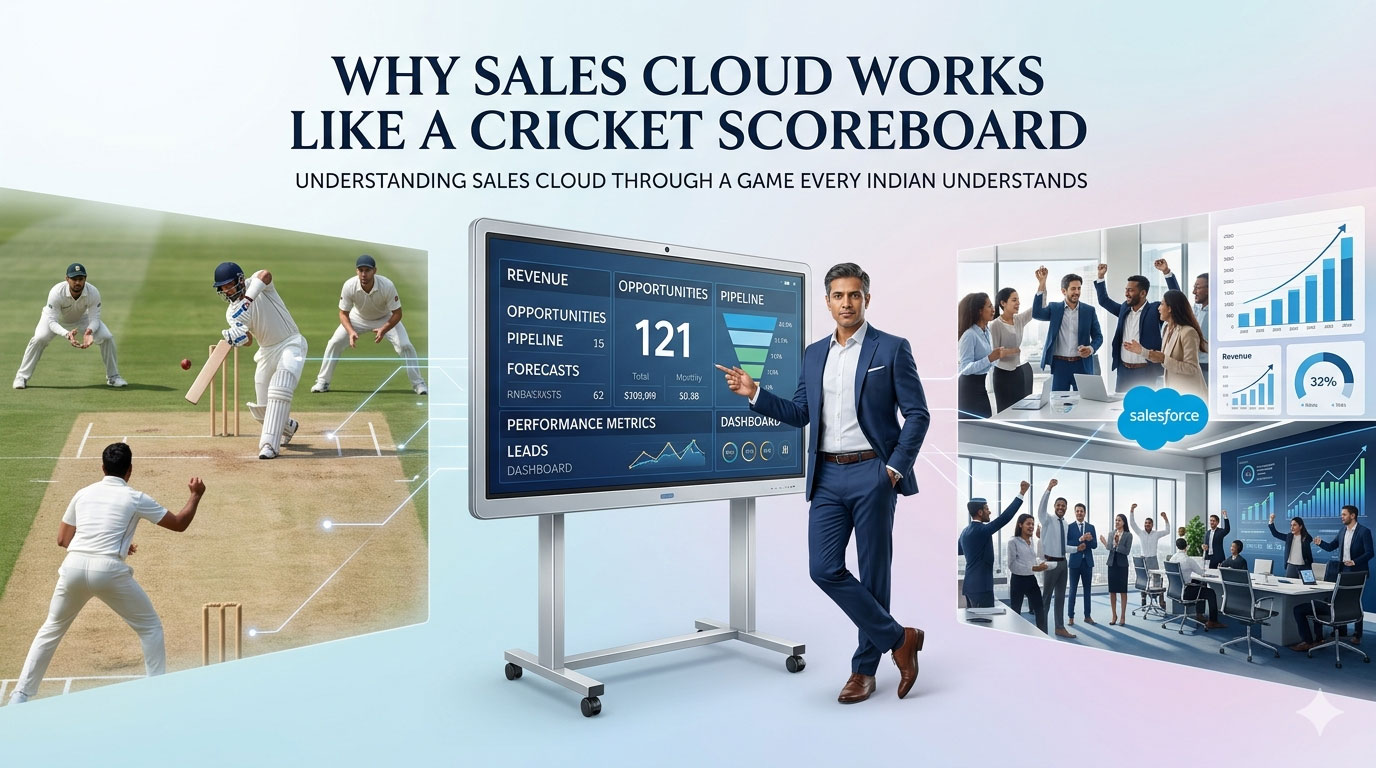
Sales Cloud does for businesses what a scoreboard does for a cricket match.
- Provides visibility
- Tracks progress
- Helps teams make informed decisions
- Shows where the business stands at any moment
Cricket Scoreboard vs Sales Cloud
| Cricket Match | Sales Cloud |
|---|---|
| Batsman | Sales Representative |
| Runs | Revenue |
| Match Scoreboard | Sales Cloud Dashboard |
| Required Run Rate | Sales Targets |
| Wickets Lost | Lost Opportunities |
| Overs Remaining | Sales Timeline |
| Match Progress | Sales Pipeline |
| Captain | Sales Manager |
| Match Strategy | Sales Process |
| Winning Probability | Revenue Forecast |
Suddenly Sales Cloud becomes much easier to understand.
What Happens During a Cricket Match?
Throughout the game, the scoreboard continuously updates.
It tracks:
- Runs scored
- Wickets lost
- Overs completed
- Strike rate
- Required run rate
Every decision depends on this information.
The scoreboard provides context.
Without context, decision-making becomes difficult.
Sales Cloud Works Exactly the Same Way
Leads
Potential customers who may become future buyers.
Opportunities
Potential revenue currently being pursued.
Accounts
Organizations doing business with your company.
Contacts
People associated with those organizations.
Forecasts
Expected future revenue.
Dashboards
A real-time view of business performance.
Together, they provide visibility into the sales journey.
A Real Salesforce Scenario
Imagine a software company.
The company has:
- 20 Sales Representatives
- Hundreds of active opportunities
- Thousands of leads
Without Sales Cloud:
- Managers rely on spreadsheets
- Updates come through emails
- Forecasts are based on assumptions
- Reporting becomes difficult
With Sales Cloud:
- Pipeline value
- Opportunities by stage
- Expected revenue
- Team performance
- Monthly forecasts
The difference is visibility.
Why Sales Managers Love Sales Cloud
Think about a cricket captain.
A captain constantly monitors:
- Current score
- Match conditions
- Required run rate
- Remaining wickets
Based on this information, strategy changes.
Sales managers operate the same way.
They continuously review:
- Revenue targets
- Opportunity pipeline
- Conversion rates
- Forecast accuracy
Key Takeaways
- A cricket match without a scoreboard is difficult to manage.
- A sales organization without visibility faces the same challenge.
- Sales Cloud acts like a business scoreboard.
- Leads, Opportunities, and Forecasts provide visibility into sales performance.
- Managers use Sales Cloud to make informed decisions.
- Visibility improves forecasting and revenue growth.
- Businesses cannot improve what they cannot measure.
Final Thought
A scoreboard does not score runs.
A scoreboard does not bowl deliveries.
A scoreboard does not win matches.
Yet every successful cricket team depends on it.
Similarly, Sales Cloud does not close deals on its own.
But it provides the visibility, insights, and forecasting needed to help organizations win.
That is why Sales Cloud works like a cricket scoreboard.
And just like great teams rely on scoreboards, great businesses rely on visibility.
Continue Learning
If you enjoy Salesforce concepts explained through real-world analogies, visual learning, and practical business scenarios, join our WhatsApp Channel.
- Sales Cloud Concepts
- Salesforce Development
- Lightning Web Components
- Integration Learning
- Career Guidance
- Industry Insights
- Learning Resources
👉 Join Our WhatsApp Channel
https://whatsapp.com/channel/0029VbBo7ohC6ZvdbkTpld2f
About Salesforce Gyaan Academy
At Salesforce Gyaan Academy, we simplify complex Salesforce concepts using:
- Real-life analogies
- Visual learning
- Business scenarios
- Practical examples
- Architecture thinking
- Real-world projects
Because understanding concepts is far more valuable than memorizing syntax.
📧 Email: salesforcegyaan@gmail.com
🌐 Follow Salesforce Gyaan Academy for more analogy-driven Salesforce learning.