
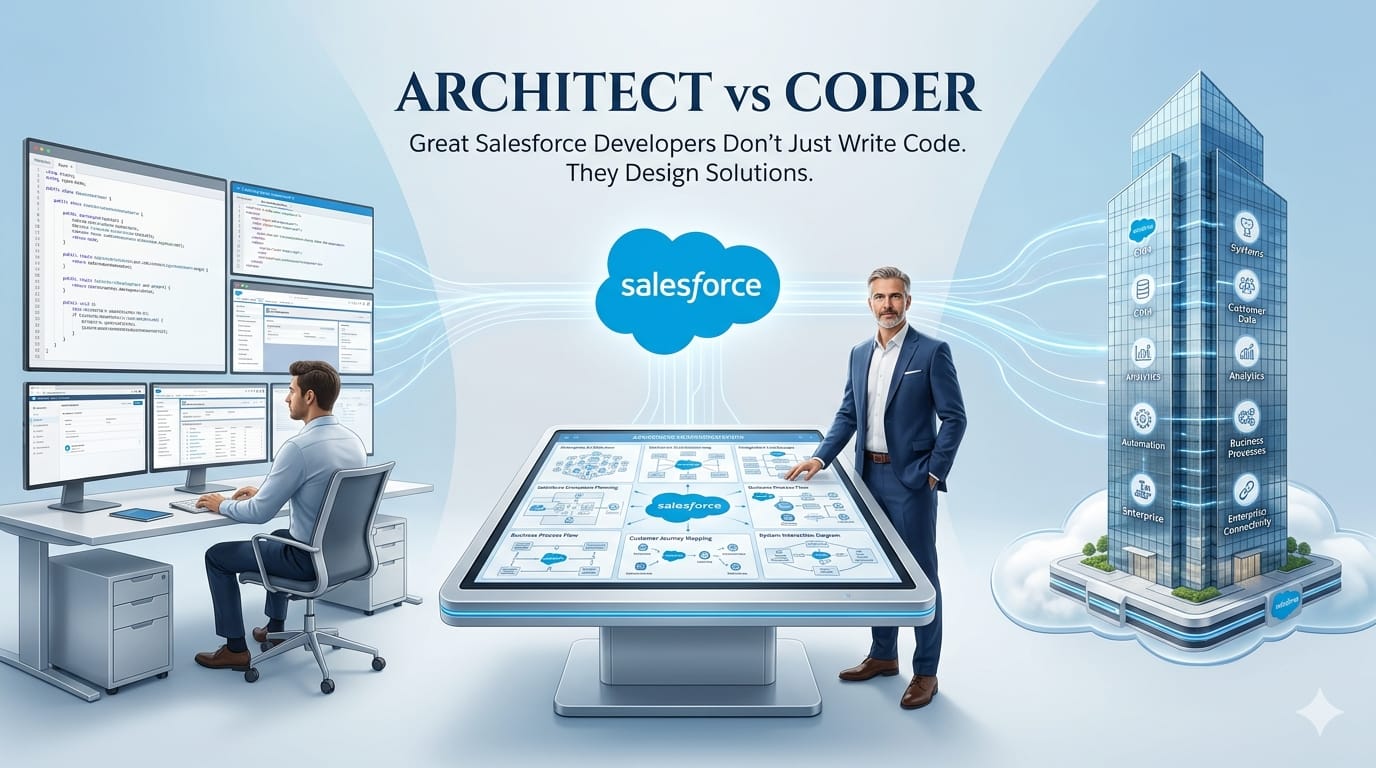
Introduction
Many Salesforce professionals believe that learning Apex, Lightning Web Components (LWC), Flows, Integrations, and AI tools is enough to become a great developer.
But after working on real-world projects, most teams discover an important truth:
Companies don’t pay developers to write code.
Companies pay developers to solve business problems.
The difference between an average Salesforce Developer and an exceptional Salesforce Developer is often the same as the difference between a mason and an architect.
Let’s understand why.
The Day a House Was Built Without an Architect
Imagine you decide to build your dream house.
Excited about the project, you hire workers and immediately ask them to start construction.
The workers begin laying bricks.
Within a few days, questions start appearing:
- How many rooms should the house have?
- Where should the kitchen be located?
- What about ventilation?
- Where will electrical wiring go?
- How will water pipelines be routed?
- What if you want to add another floor in the future?
Suddenly everyone realizes something important.
Construction started before planning.
The result?
- More cost
- More rework
- More confusion
- More delays
And sometimes, a completely broken design.
This is exactly why successful construction projects never start with bricks.
They start with a blueprint.
The Architect Thinks Before Anyone Builds
Before a single brick is placed, an architect creates:
- A blueprint
- Room layouts
- Structural designs
- Electrical planning
- Water pipeline planning
- Future expansion considerations
The architect’s job is not to lay bricks.
The architect’s job is to ensure that every brick contributes to a larger vision.
Only after the design is complete does construction begin.
The architect thinks before building.
Salesforce Projects Work Exactly the Same Way
Imagine a business approaches your team and says:
“We need an automated customer onboarding process in Salesforce.”
Many developers immediately start thinking about:
- Apex Classes
- Flows
- Lightning Web Components
- Validation Rules
- APIs
But exceptional developers ask different questions first:
- What business problem are we solving?
- Who will use this process?
- What data is involved?
- Which systems participate in the process?
- What happens when the business grows?
- What happens when requirements change?
- How will this be maintained after one year?
The difference is subtle.
One person is thinking about implementation.
The other person is thinking about the solution.
Coder Mindset vs Architect Mindset
| Coder Mindset | Architect Mindset |
|---|---|
| How do I build this? | Why are we building this? |
| Focus on code | Focus on outcomes |
| Solves tasks | Solves business problems |
| Thinks about today | Thinks about future growth |
| Feature-driven | Business-driven |
| Implementation first | Design first |
| Delivers functionality | Delivers value |
Both skills are important.
But organizations typically reward professionals who can understand business requirements and design scalable solutions.
A Real Salesforce Scenario
Let’s assume a company wants Salesforce to integrate with an ERP system.
The Coder Approach
- API Callout
- Response Parsing
- Data Mapping
The integration works. Task completed.
The Architect Approach
- How many records will be processed daily?
- What happens if the ERP system becomes unavailable?
- Do we need retry mechanisms?
- How should failures be monitored?
- What security controls are required?
- How will support teams troubleshoot errors?
- Can this design support future integrations?
Suddenly the discussion is no longer about an API call.
It becomes a conversation about reliability, scalability, governance, and long-term business value.
This is architectural thinking.
The Five Questions Great Salesforce Developers Ask
- Why? What business problem are we solving?
- Who? Who are the users and stakeholders?
- What? What data and processes are involved?
- How? What is the most suitable technical approach?
- What If? What happens when requirements change, data volume increases, or systems fail?
The Career Shift That Changes Everything
Most Salesforce careers begin with learning:
- Syntax
- Components
- Configurations
- Features
However, the biggest career growth usually happens when a professional starts thinking beyond implementation.
The transition often looks like this:
Developer → Senior Developer → Solution Designer → Architect → Trusted Advisor
Key Takeaways
- Great Salesforce Developers solve business problems, not just technical problems.
- Coding is only one part of solution delivery.
- Architectural thinking improves scalability and maintainability.
- Apex, LWC, Flow, APIs, and AI tools are technologies—not outcomes.
- The most valuable professionals understand both business and technology.
- Long-term success comes from designing solutions, not simply implementing features.
Final Thought
Anyone can learn Salesforce syntax.
The real challenge is learning how to design solutions that continue delivering value as a business grows.
That is the moment when a Salesforce Developer stops being just a coder and starts becoming an architect.
And that shift often becomes the turning point of an entire career.
Continue Learning
If you enjoy Salesforce concepts explained through real-world analogies, visual learning, and practical business scenarios, join our WhatsApp Channel.
About Salesforce Gyaan Academy
At Salesforce Gyaan Academy, we believe successful Salesforce professionals need more than technical skills.
They need the ability to understand business problems, design scalable solutions, and communicate complex concepts using practical real-world thinking.
- Real-life analogies
- Visual learning
- Architecture thinking
- Real-world projects
- Salesforce Development
- Lightning Web Components
- Integrations
- Career Growth
Because great careers are built by solving problems—not just writing code.
📱 WhatsApp Channel: Join Now
📧 Email: salesforcegyaan@gmail.com